
apool v2 Allocator
apool v2 hands 16 KiB pages to the block sizes that are actually arriving and takes them back when they empty. The same 8 MiB that held 655 tasks of 100 B under the old fixed split now holds 46,593, and gives its memory back to the OS after a burst.
Quicx 2.0 keeps its promise — one budget, mapped once, never exceeded — and changes what happens inside it. Up to 1.0.4 the budget was split between block sizes by fixed percentages (PMAD), decided before the first task arrived. apool lets the traffic decide instead: the diagram below follows one page, page 4, through every part of it.
Architecture#
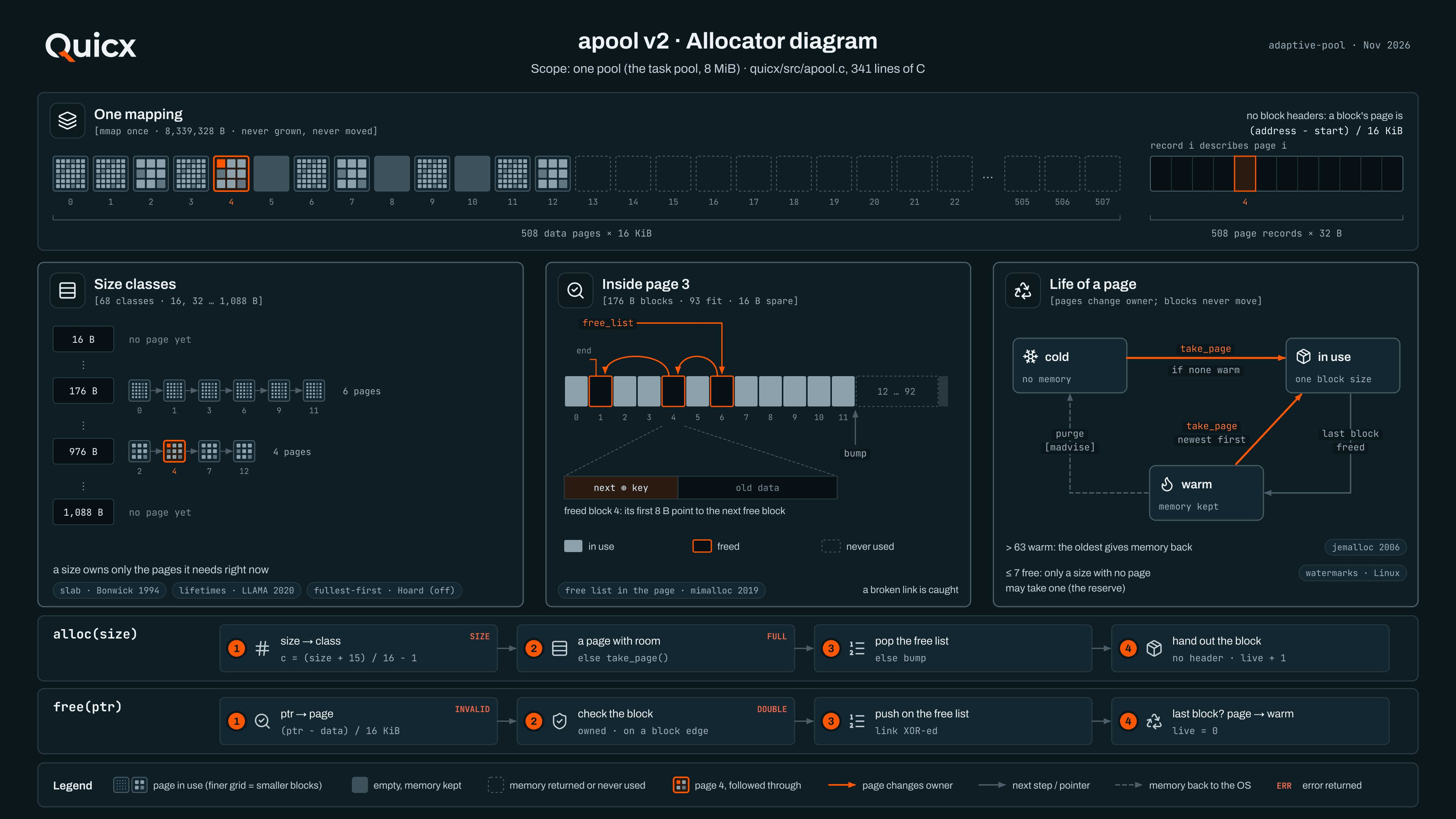
- One mapping
- The budget is one
mmapat startup, never grown or moved: 508 pages of 16 KiB, then one 32-byte record per page. Pages come first, so every page starts on an OS page boundary and can be given back. - No block headers
- A block’s page is
(address − start) / 16 KiB, and that page’s record holds everything else: the size it serves, how many blocks are live, its free list and its bump offset. A 100 B request costs a 112 B block, nothing more. - Pages per size
- 68 sizes, 16 B to 1,088 B in steps of 16. A size takes a free page only when it has no room left, and a page whose last block is freed goes back to a shared list where any size can take it next. Live blocks never move.
- Inside a page
- Freed blocks form a list through their own first 8 bytes; blocks never used yet are handed out from a bump offset. Both are O(1).
- One block per task
- A task is the 64 B
Taskrecord with its payload right behind it — one allocation, one free, freed the momentMSG_TASKis sent. Connections and workers come from a separate 3-page control pool, so a full task pool can never lock a worker out.
Ideas from the literature#
Every idea in apool v2 comes from a published allocator and sits behind its own switch, so its effect could be measured on its own. Each one can be turned on or off in the [allocator] section of quicx.conf.
| Feature | Idea from | What it buys | Default |
|---|---|---|---|
| Pages move between sizes | slab allocator (Bonwick 1994), mimalloc, memcached | 46,593 tasks of 100 B instead of 655; follows size changes without a restart | always |
| Reserve | Linux zone watermarks, memcached | after a flood of one size, a new size still gets room (16 tasks of 900 B instead of 0); costs 1.4 % of capacity | on |
| Hardening | mimalloc secure mode | free-list links XOR-encoded with a per-pool key; double frees and overwritten links are caught; about 1 ns per task (M4 Pro) | on |
| Purge with a warm list | jemalloc, mimalloc | beyond 63 empty pages the oldest gives its memory back to the OS; 1,104 KB held after a drain instead of 8,096 KB | on |
| Lifetime classes | LLAMA (Maas et al. 2020) | long-lived blocks get their own pages; 7,648 instead of 16 tasks fit after a pinning pattern — when a caller passes a hint | available, unused |
| Fullest page first | Hoard (Berger et al. 2000) | measured: no gain on queue traffic, 5 ns slower per task | off |
Benchmarks#
The allocator on its own, with the same workloads on PMAD, the first adaptive pool and apool v2, on the default 8 MiB. Capacity and the queue depths are identical on the Apple M4 Pro and the Intel i3-2100; the time per task is the median of 5 runs.
| PMAD (1.0.4) | apool v1 | apool v2 | |
|---|---|---|---|
| 100 B tasks that fit | 655 | 47,450 | 46,872 |
| 900 B after a flood of 40 B | 180 | 0 | 16 |
| 900 B with 1 in 20 tasks pinned | 180 | 0 | 7,648 |
| deepest mixed FIFO queue | 5,312 | 30,720 | 29,952 |
| ns per task, M4 Pro | 13.3 | 24.9 | 14.8 |
| ns per task, i3-2100 | 43.3 | 103.3 | 72.8 |
Settings#
The defaults are the measured best: 16 KiB pages (4–64 KiB were compared), 63 warm pages and 7 reserved pages at the default budget. warm_pages and reserve_pages in quicx.conf override the last two; the page size is fixed at build time.